SeisNAV
AI-powered platform that detects collapsed buildings from satellite imagery and generates safe navigation routes for disaster response teams.
Details
Problem
After earthquakes, analysts manually map collapsed buildings and blocked roads from satellite images for disaster teams. This process is slow, labor-intensive, and must be repeated every time new satellite data arrives — costing critical time when lives are at stake.
Solution
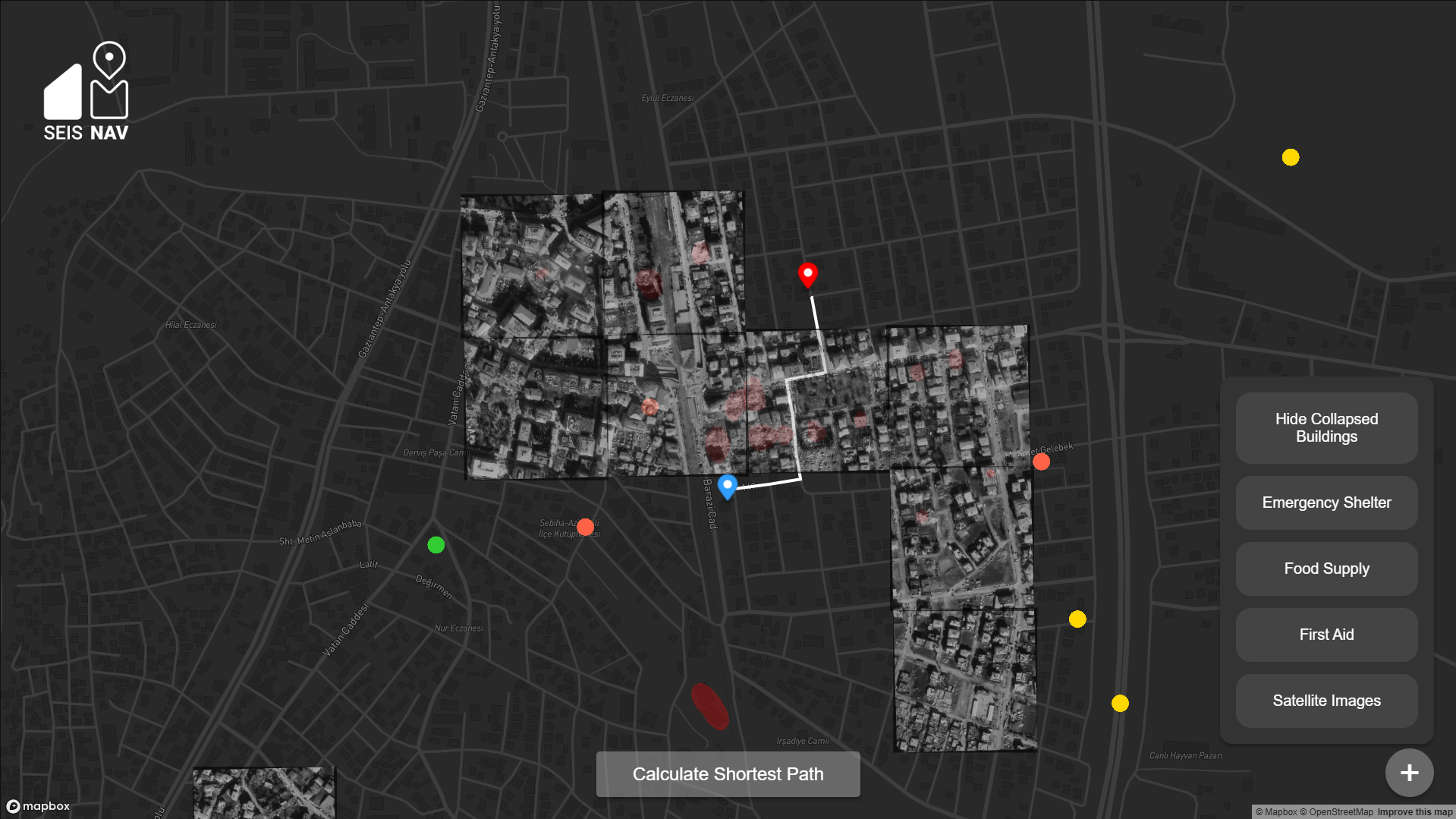
SeisNAV automates collapse detection and emergency routing. Upload satellite imagery, get instant building damage assessment and safe navigation paths. The platform bridges the gap between raw satellite data and actionable decision-making for first responders.
Pipeline
- Collapse Detection — Computer vision model trained on Maxar satellite datasets identifies collapsed structures and debris polygons from post-disaster imagery
- Collapse Mapping — Detected damage polygons are migrated to OpenStreetMap, overlaid with road networks, hospitals, fire stations, and emergency infrastructure
- Route Generation — Adaptive routing engine uses ML-derived obstruction masks to calculate safe passages around damaged areas via Mapbox GL JS and Turf.js
- Interface — Real-time interactive map for disaster response teams, NGOs, and civilians
Model Training
Trained 6 different model configurations across annotation methods, preprocessing tools, and augmentation parameters. Final model achieves 67.5% mIoU on collapsed building segmentation using Roboflow-based pipelines.
Stack
Python · Roboflow · Mapbox GL JS · Turf.js · OpenStreetMap · Maxar Satellite Data
Team
Michele Cobelli, Bradley Manucha, Abdellah Choufani, Ertuğrul Akdemir
IAAC — Master in AI for Architecture and the Built Environment, 2024
Services
Computer Vision
Disaster Response
GIS
Mapbox
Year
2024